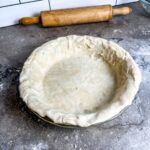
Easy 3 Ingredient Single Pie Crust
Create the perfect pie crust with our Easy 3 Ingredient Single Pie Crust. It's quick, foolproof, and oh-so-flaky.
Servings: 8
Calories: 184kcal
Ingredients
- 1 ¼ cups All Purpose Flour
- ½ teaspoon Salt
- ½ cup Shortening
Instructions
How to Mix Pie Dough
- Combine flour and salt in a large mixing bowl.1 ¼ cups All Purpose Flour, ½ teaspoon Salt
- Add shortening to the flour mixture. Use a pastry blender or your fingers to mix until small balls of flour-covered shortening remain. Do NOT over-mix. Less is better here.½ cup Shortening
- Add COLD WATER 1 Tablespoon at a time. Using a fork, I like to work from one edge and bring more flour/shortening mixture to the wetter dough as I add water. I used 5 Tablespoons this time. Handle as little as possible for the flakiest crust.
Rolling Out Pie Crust
- When dough comes to a ball you are ready to roll out. Sprinkle a light coating of flour on your surface to prevent the dough from sticking.
- Flatten with your hands into a round disk. Use a rolling pin to roll out thin and even thickness. Sprinkle with flour if needed.
- Roll from the center until the pie dough is large enough for your pie pan.
- Test the ideal size by placing your pie pan on top of the rolled out dough. Make sure the dough is able to come up the sides.
Moving and Shaping Pie Crust
- Place the rolling pin on the pie dough furthest from you. Pick up the edge of the dough and roll it onto the rolling pin.
- Transport the crust to the pie pan. Position at the edge of the pie pan and unroll giving slack into the bottom of the pie pan.
- Trim extra crust if needed leaving some dough hanging over edge. Fold extra dough under all around the edge and crimp with your fingers.
Notes
Baked Crust: Beat together 1 egg yolk and 1 Tablespoon of water and brush onto the unbaked crust. Bake the crust at 425 degrees until golden brown then fill as desired.
🧡 Alpha Gal Notes: This recipe is one that can easily be enjoyed. Be aware of any specific needs and read labels for all ingredients.
Nutrition
Calories: 184kcal | Carbohydrates: 15g | Protein: 2g | Fat: 13g | Saturated Fat: 3g | Polyunsaturated Fat: 4g | Monounsaturated Fat: 5g | Trans Fat: 2g | Sodium: 146mg | Potassium: 21mg | Fiber: 1g | Sugar: 0.1g | Vitamin A: 0.4IU | Calcium: 3mg | Iron: 1mg
